Health and Wellness
Bright boxes, health claims, and cartoon mascots turned children’s food into a marketing system. Here is what parents need to know.

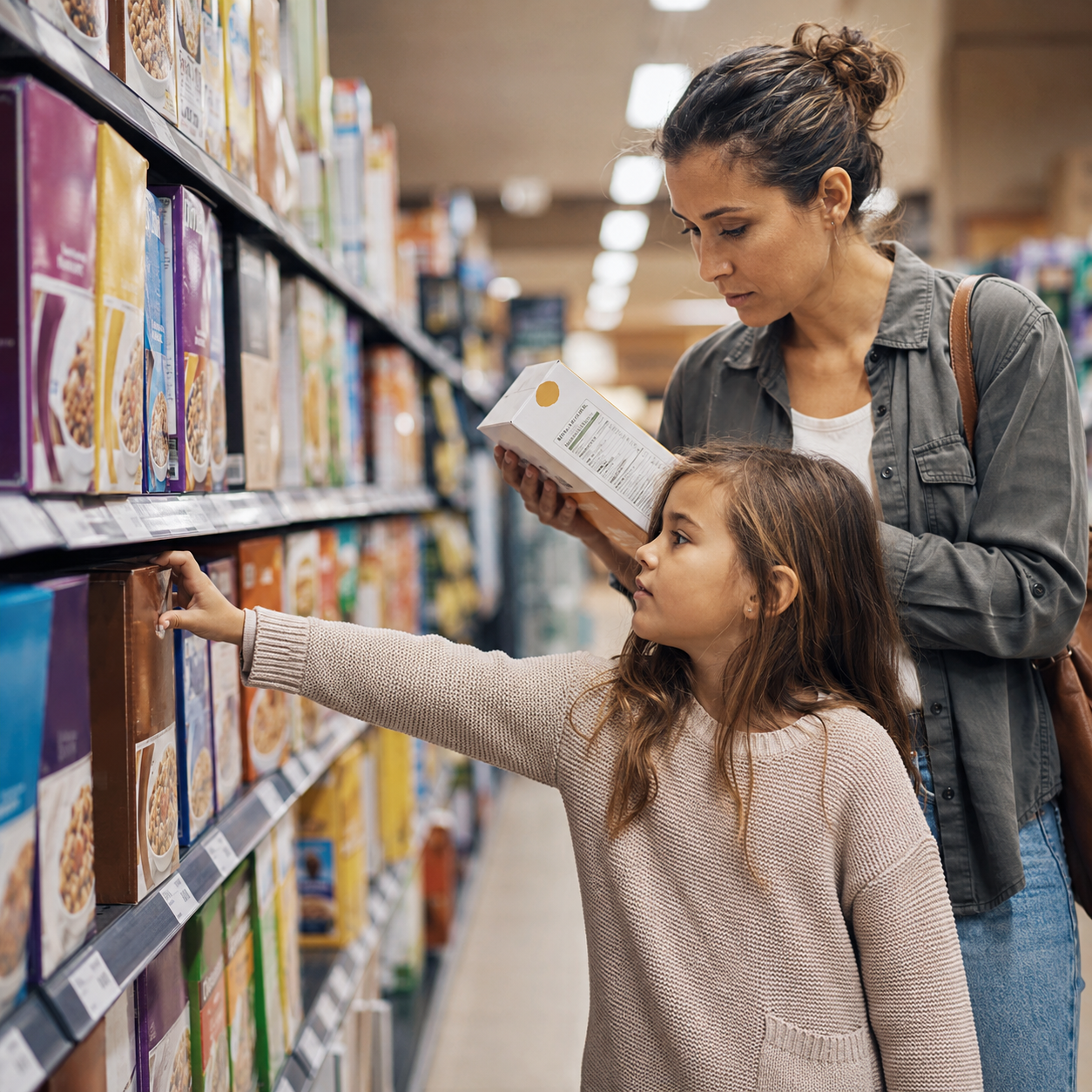
What is the cereal aisle really selling children? A clear look at ultra-processed food, packaging claims, food dyes, and better choices for families.
Walk down the cereal aisle and it does not feel like a warning sign.
It feels normal.
Bright boxes. Cartoon animals. Rainbow colors. “Made with whole grain.” “Good source of vitamins.” “Kid approved.” “No artificial flavors.” “Part of a balanced breakfast.”
To a child, it looks fun.
To a parent, it looks acceptable.
That is the design.
The modern cereal aisle is not just selling breakfast. It is selling speed, reassurance, sweetness, habit, and trust. It is selling parents the feeling that they are making a reasonable choice in a busy life. It is selling children a food identity before they are old enough to understand what is being sold to them.
And that is the problem.
This is not about blaming parents.
Parents are tired. Families are stretched. Grocery prices are high. Schedules are full. Nobody wants to stand in an aisle after work and decode every ingredient like a chemist.
The real issue is that the modern food system has made the source of food harder to see and the marketing easier to believe.
Processing food is not new.
Frozen blueberries are processed. Plain yogurt is processed. Cheese is processed. Oats are processed. Real bread is processed.
Human beings have always processed food. We have dried it, smoked it, fermented it, salted it, cooked it, ground it, preserved it, and stored it. Processing helped families survive winters, preserve harvests, and feed communities.
That is not the same as ultra-processing.
Ultra-processing is different because the food is no longer built around a recognizable ingredient. It is built around a formula.
Real food begins with soil, animals, trees, gardens, kitchens, and farms.
Ultra-processed food begins with industrial ingredients, additives, flavor systems, color systems, texture systems, and shelf-life goals.
That formula is not accidental.
Artificial colors make cheap ingredients look exciting.
Artificial flavors make low-cost inputs taste bigger than they are.
Preservatives help products survive warehouses, trucks, heat, cold, and months of storage.
Emulsifiers create smoother textures. Stabilizers protect appearance.
Sweeteners and refined starches increase reward.
A company can sell strawberry-flavored cereal without using meaningful amounts of strawberries.
That is not agriculture.
That is theater.
The shift is not small.
From 1999 to 2018, American children and teenagers increased their intake of ultra-processed foods from 61.4 percent of total calories to 67 percent. During that same period, calories from unprocessed or minimally processed foods fell.
That is not just a change in taste.
That is a restructuring of childhood.
More recent federal data shows the pattern is still deeply embedded. From August 2021 through August 2023, American youth ages 1 to 18 consumed 61.9 percent of their daily calories from ultra-processed foods.
For millions of children, ultra-processed food is not an occasional treat.
It is the base layer of the diet.
A child does not design the food environment. A child does not choose which products receive shelf space. A child does not negotiate advertising budgets, packaging language, school snack options, or the price gap between fresh food and shelf-stable calories.
The child simply enters the system.
And the system is ready for them.
The American family changed.
The food industry changed with it.
More households had two working parents. More meals were eaten in cars, after practice, at desks, in front of televisions, or between obligations. Time became scarce. Convenience became valuable.
The food industry did not create every pressure families faced.
But it learned how to profit from them.
Breakfast became cereal bars.
Fruit became fruit snacks.
Juice became fruit-flavored drinks.
Lunch became packaged kits.
Dinner became frozen trays.
Dessert became breakfast.
The transaction was simple:
Food companies sold speed to parents and excitement to children.
The parent saw convenience.
The child saw fun.
The company saw margin.
That bargain now sits in millions of pantries.
For years, Americans were told the food crisis was mainly a failure of discipline.
Eat less.
Move more.
Try harder.
That story was useful because it moved attention away from the food itself. If the problem was only willpower, then the product could remain innocent.
But one of the most important nutrition studies in modern food science challenged that story.
Researchers led by Dr. Kevin Hall at the National Institutes of Health placed participants inside a controlled clinical setting and compared an ultra-processed diet with an unprocessed diet.
The meals were matched for presented calories, sugar, fat, sodium, fiber, and macronutrients.
In other words, researchers controlled many of the things people usually blame.
Still, participants eating the ultra-processed diet consumed more calories and gained weight. On the unprocessed diet, they lost weight.
The implication was uncomfortable.
It was not simply that people were making bad choices.
The food itself was changing the choice.
Ultra-processed foods are often softer, faster to chew, easier to swallow, more calorie-dense, lower in intact structure, and more rewarding to the brain. They can be eaten quickly, often before fullness signals catch up.
A bowl of neon cereal does not behave in the body like eggs, oats, fruit, beef, potatoes, yogurt, or beans.
The body knows the difference, even when the front of the package tries to blur it.
Children are the ideal audience for engineered food.
They respond to sweetness, color, shape, cartoons, crunch, novelty, games, collectible packaging, and familiar characters.
Their taste preferences are still forming.
Their brains are still developing.
Their loyalty can last for decades.
Food companies understand this.
The packaging speaks to the child.
The health claim speaks to the parent.
That is the architecture.
A cereal box does not need to convince a child with nutrition science. It needs to create desire. It needs color, character, sweetness, and recognition.
Then it needs the parent to feel just reassured enough not to say no.
That is why the front of the box matters so much.
The front is persuasion.
The ingredient list is evidence.
For years, parents who questioned artificial food dyes were treated as overly suspicious.
Many parents said they noticed behavior changes after their children ate bright red candy, neon cereal, artificially colored drinks, or colorful packaged snacks.
They saw agitation, hyperactivity, mood swings, or trouble settling down.
That does not mean artificial dyes explain every attention or behavior problem.
They do not.
Children are complex. Sleep, genetics, school stress, screen exposure, family stress, diet, neurobiology, and environment all matter.
But the science around synthetic food dyes has become harder to ignore.
California’s Office of Environmental Health Hazard Assessment reviewed evidence on synthetic food dyes and concluded that some children appear sensitive to them, with possible links to hyperactivity, inattentiveness, restlessness, and other neurobehavioral effects.
Again, that does not mean every child reacts the same way.
But it does raise a simple question:
Why are unnecessary synthetic dyes in children’s food at all?
Red Dye No. 3 became the clearest symbol of the problem. In January 2025, the FDA revoked authorization for FD&C Red No. 3 in food and ingested drugs after evidence showed cancer in laboratory animals. Food manufacturers were given time to reformulate.
The obvious question is also the disturbing one.
If the dye added no nutrition, if companies could eventually remove it, and if its main purpose was cosmetic, why was it allowed in foods children ate for decades?
The answer is brutally simple.
It made products look better.
A cosmetic effect helped sell food.
That fact should linger.
The modern food package is designed to create trust before scrutiny begins.
“Made with whole grain.”
“Good source of vitamins.”
“Natural.”
“Plant-based.”
“Gluten-free.”
“Fortified.”
“No artificial flavors.”
“Made with real fruit.”
“Kid approved.”
These phrases can be technically true and still misleading.
A cereal can contain whole grain and still be loaded with sugar and artificial dyes.
A fruit snack can be made with some fruit and still be mostly sugar, starch, oil, and flavoring.
A product can be gluten-free and still be ultra-processed.
A food can be fortified with vitamins and still be a poor daily staple.
The health halo works because parents are busy.
No mother standing in a grocery aisle after work wants to become a chemist, investigator, and procurement officer before dinner.
The industry knows this.
That is why the front of the package carries comfort.
The back carries the truth.
The simplest rule is still the strongest.
Do not trust the front of the package.
Turn it around.
Look for long ingredient lists, artificial colors, artificial flavors, corn syrup, modified food starch, maltodextrin, hydrogenated oils, protein isolates, artificial sweeteners, preservatives, emulsifiers, multiple added sugars, and ingredients you would never use in your own kitchen.
Then ask one question:
Can I picture where this came from?
You can picture an apple tree.
You can picture a cow.
You can picture an egg.
You can picture oats in a field.
You can picture a potato in the ground.
You can picture milk from a dairy farm.
Can you picture Red 40?
Can you picture maltodextrin?
Can you picture polysorbate 80?
Can you picture artificial blue raspberry flavor?
That pause is useful.
It does not require perfection.
It requires awareness.
There is another test, older and more reliable.
Could this food exist without a factory?
An egg can.
A steak can.
A carrot can.
Milk can.
Butter can.
An apple can.
A potato can.
Honey can.
Oats can.
Cheese can.
But neon cereal cannot.
Fruit snacks cannot.
Shelf-stable snack cakes cannot.
Artificially colored drinks cannot.
Most packaged lunch kits cannot.
That does not mean a child can never eat them.
It means they should not become the foundation of childhood.
The issue is not purity.
Purity is a trap. It makes parents feel either righteous or defeated.
The better goal is pattern change.
More food from farms and kitchens.
Less food from formulas.
More meals with recognizable ingredients.
Fewer products that require a chemistry degree to understand.
The answer is not panic.
The answer is relationship.
For decades, the food system made the source of food less visible. Families learned brand names instead of farmer names. They learned package claims instead of growing practices. They learned calories, macros, and labels, but not soil, feed, pasture, seasonality, or processing.
That distance created room for confusion.
When families do not know who grew the food, they rely on the package.
When they do not know the farm, they rely on the claim.
When they do not know the process, they rely on trust.
And trust is exactly what the modern food system has spent.
This is why the renewed interest in local farms is not just nostalgia.
It is not a lifestyle accessory.
It is a response to opacity.
Families are trying to shorten the distance between the plate and the source.
They want beef from a rancher they can name.
Eggs from hens raised by someone accountable.
Milk, produce, honey, fruit, pork, chicken, and seasonal food that does not require a marketing department to explain itself.
They are not asking for perfection.
They are asking for clarity.
Most parents already know they want better food for their children.
They want fewer mystery ingredients.
They want fewer fake health claims.
They want fewer grocery aisle decisions that feel like a guessing game.
But they are busy.
Most families do not have time to research every ingredient, investigate every label, call every farm, compare every pickup option, or chase scattered Facebook posts each week.
That gap is exactly why The Farm Ledger exists.
The Farm Ledger is a free weekly email from Farm Allegiance that curates what trusted local farms have available right now — beef bundles, seasonal produce, eggs, dairy, CSA boxes, farmers market schedules, and direct ordering links.
Think of it as a clearer, more useful version of the weekly grocery store ad, but for real food from farms you can actually know.
No inventory.
No middleman taking over the relationship between farm and family.
No pressure to buy what you do not need.
You simply open one clean email each week, see what is fresh and available near you, and order directly from the farms you trust.
For families, it removes the friction between knowing better and doing better.
For farmers, it creates more direct, repeat customers without forcing them to become marketers or give up control of their pricing and practices.
The cereal aisle is designed to make processed food feel simple.
The Farm Ledger makes real food simple.
Every Monday, Farm Allegiance sends families one clear list of trusted local farms, beef bundles, eggs, dairy, produce, CSA boxes, farmers market schedules, and direct ordering links.
No noise.
No mystery.
No guessing.
Just better food from people you can actually know.